In This Article You’ll Learn
- The different types of trail race fuel
- The pros and cons of each
- When each food works best
- How to build your own race menu
- My favorite race-day foods
Here you are running your first trail race. You’ve done road 10Ks, Half’s, and marathons. You know you’re going to run into this aid station full speed grab your little cup of water and maybe a banana. Except that isn’t how we roll in the trail and ultra world. You cruise in and see an abundance of cookies, potato chips, brownies, grilled cheese, broth, coke and candy! So much candy. How do you know what to grab? Or more importantly what not to grab.
Let’s simplify it.
| Fuel | Best For | Easy to Carry | Quick Energy | My Recommendation |
|---|---|---|---|---|
| Gels | Speed & convenience | ⭐⭐⭐⭐⭐ | ⭐⭐⭐⭐⭐ | Great starting point |
| Chews | Steady fueling | ⭐⭐⭐⭐☆ | ⭐⭐⭐⭐☆ | Excellent for beginners |
| Sports Drinks | Fuel + hydration | ⭐⭐⭐⭐⭐ | ⭐⭐⭐⭐☆ | One of my favorites |
| Real Food | Long races | ⭐⭐☆☆☆ | ⭐⭐⭐☆☆ | Great later in races |
| Candy | Quick pick-me-up | ⭐⭐⭐⭐☆ | ⭐⭐⭐⭐☆ | Use as a supplement |
First and foremost remember we are an experiment of one. What works for Killian Jornet may not work for you. Some runners thrive on only gels, some only on solid food, some rely totally on high sugar candies. Most of us end up eating a mix of all of it. A quick breakdown of the major choices:
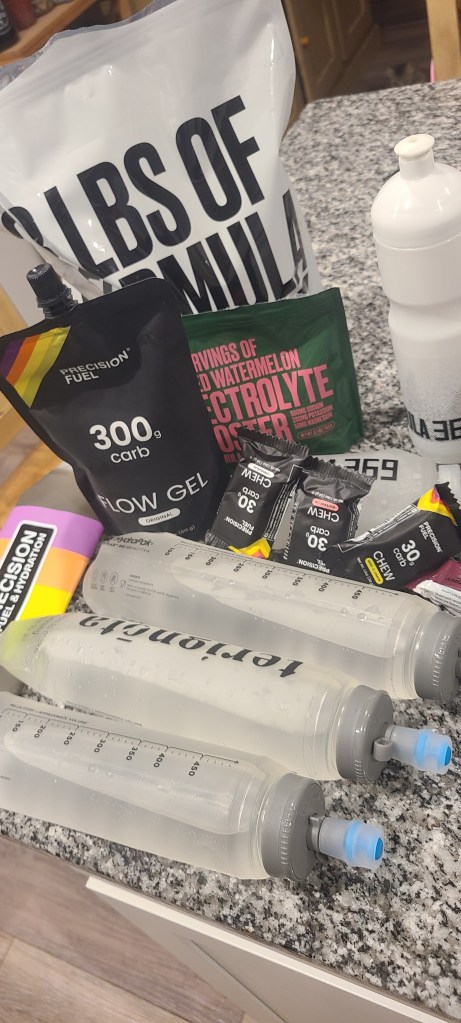
Gels-GU, Precision, UCan, and so many many more.
Pros:
- Fast Carbohydrates
- Easy to Carry
- Convenient
- Easy to calculate carbs/calories
- Available with or without caffeine
- Easy to consume while moving
Cons:
- possible GI issues after several hours
- Can get expensive
- Creates wrappers that must be packed out—always leave the trail cleaner than you found it.
- Sticky as well as some runners do not like the texture
- Have to use whole package at once
Coach’s Take:
Gels are the gateway fuel you’ve used them before with road races and every race will probably have gels. Gels are hard to take for longer efforts because you have to have so many of them and because you get tired of the texture and taste at some point. They are easy to calculate all your carbs and calories. Personally I mix them in throughout the run so I don’t get fatigued with them.
Chews-ClifBloks, Precision Chews, SIS, etc.
Pros:
- Easy to carry
- Convenient
- More satisfying because you have to chew them
- Easy to calculate carbs/calories
- available with or without caffeine
- Less messy than Gels
- Easy to spread intake
Cons:
- Equally as expensive as Gels
- Creates wrappers that must be packed out—always leave the trail cleaner than you found it.
- Can become difficult to chew during hard efforts
- If it is cold they can become harder and also could be stickier in hotter weather
- Require water
Coach’s Take:
Chews are a great middle ground between gels and real food. They’re easy to carry and easy on the math skills for carbs. I recommend chews to most beginning trail runners because of the simplicity to breakdown what you need per hour.
Sports Drinks-Gatorade, Powerade, Skratch, Tailwind, Hyperlyte, 369 etc.
Pros:
- Provides Carbohydrates and Hydration at the same time
- Easy to consume on the move
- Reduces the amount of extra fuel like gels or chews
- May also contain electrolytes
- Can be easier on the stomach than solid food
- Perfect for runners who struggle to eat while moving
Cons:
- Easy to under-fuel
- Easy to over-fuel
- Can create taste fatigue similar to Gels and Chews after using for long periods of time
- Mixes may not have the amount of carbs or sodium you need causing you to have to refill more.
- Concentrated mixes can cause stomach issues if not practiced beforehand
- Can be more difficult to adjust your intake if weather changes
Coach’s Take:
Sports drinks are one of my favorite ways to fuel during long efforts. They allow you to hydrate and consume carbohydrates at the same time. However, don’t assume your hydration needs and carbohydrate needs will always match. On a cool day you may drink less but still need plenty of carbohydrates. On a hot day you may drink much more than usual. Practice with your chosen drink during long runs so you understand how it works for your body.
Additional Note:
Remember: Not all sports drinks are created equal. Some are designed primarily for hydration and contain very little carbohydrate, while others are formulated to be a major source of your race-day fuel. Always read the nutrition label so you know how many grams of carbohydrates and how much sodium you’re actually getting per serving.
Real Food-Bananas, Potatoes, Rice balls, PB&J, Quesadillas, Pretzels, Chips, and many many other items
Pros:
- Delicious
- Very satisfying due to not having it constantly through the run
- Good sources of Carbohydrates and sodium depending on item
- Free
- Helps to soak up excess items in your stomach
- Handles cravings late in the race
Cons:
- Different sizes and amounts make it difficult to add into your fuel plan
- not very portable
- Not consistently at every aid station
- May take longer to digest during harder efforts
Coach’s Take:
Real food is the secret weapon for ultra runners. It breaks up the monotony of gels, drinks, chews and so on. Many runners appreciate eating something that feels like real food after hours of sweet gels and drinks. When you get into an aid station your body will tell you what your craving. If you look directly at chips and they look delicious you should grab them. Your body is telling you that you need some sodium.
Fun Food-Gummy bears, skittles, Cookies, M&M’s etc.
Pros:
- Quick source of easily digested Carbohydrates
- Sugar rush feeling
- Able to carry them
Cons:
- May not keep you full for long
- Need a lot to use as Carbohydrate source
- Not easy to work into a specific fueling plan
Coach’s Take:
Candy and Cookies are another item that should be utilized at the aid station. They provide quick sugary carbohydrates that you need to get you going if your feeling low. They’re tasty and plentiful but it’s hard to rely on just candy for along effort mostly because you have to eat so many of each for just one portion.
My personal choices for fueling is usually very diverse. I eat Pop-Tarts before a race, then I use Formula 369 as a Carbohydrate and Sodium base then add in chews to supplement what I’m missing from the sports drink. I eat real food throughout the day to break up the monotony of carb drink and chews. I use Cola or caffeine pills late in race or in the middle of the night to keep me going and aware. I am not a huge candy person mostly because I just don’t enjoy the sugar but I will devour any fruit that is at the aid station.
On your way into an aid station do a self check. Ask yourself what do I want to eat and do I need refills? If your brain says you want a cookie that’s what you need to look for when you get there. You want sugar, so when you enter the aid station that’s what you need to look for. Volunteers are usually present and very willing to help you refill while you are scanning the table for food. Get what you need and keep moving. Don’t stand there trying to decide what looks good. Have a plan before you arrive. I tell my athletes no more than 3 minutes per aid station.
Common mistakes:
- Carrying too much food-More weight to carry
- Carrying only one type of fuel- Keep it mixed up so you don’t develop taste fatigue
- Never practicing with aid-station foods
- Trying products you’ve never used
- Ignoring what your stomach is telling you-This is your body telling you what you need

Final Thoughts:
It doesn’t matter what Instagram Nutrition is famous right now. What matters is what works consistently for you. You need to practice your fueling every long run so that on race day there are no surprises.
Practice
Take notes
Read notes and adjust
Repeat
Coach Adam’s Quick Tip
If you’re new to trail racing…
Don’t carry six different fuel options.
Pick two or three.
Practice with them.
Master those first.
You can always expand your menu as you gain experience
Race Fuel Checklist
- Mix of quick and solid carbohydrates
- Electrolytes
- Water plan
- Backup fuel
- Foods you’ve already tested
- Enough fuel to reach the next aid station
Ready to Take the Next Step?
If you’re training for your first trail race, 50K, or ultramarathon and want personalized guidance on training, nutrition, and race-day strategy, I’d love to help.
At Black Sheep Running, my goal is simple: help everyday runners discover they’re capable of more than they ever imagined.
Learn more about my coaching here. Book Your Free Consultation
Trail Nutrition Series
How Many Carbs Do You Need During a Trail Race?


Leave a Reply