Imagine getting to mile 20 of your race feeling strong… only to suddenly feel like someone pulled the plug on your energy.
That’s exactly what happens to many runners who don’t fuel properly.
One of the most common questions I get from new athletes is:
“How much am I supposed to eat during my race?”
This is also one of the best questions you can ask! We know that if you eat too little, you’ll crash before you’re done running, creating a mighty death march to the finish. Eat too much and you’ll be bloated and have GI issues, creating a horrible race day experience. The good news is that there is a fueling strategy that works for everyone. The challenge is finding the one that works for you. The bad news is that what works for one runner may not work for another.. One athlete might excel at a 50-miler only using liquid nutrition that is 100 grams of carbs per hour, while that could totally make you run for the side of the trail. Let’s talk about how to make a fueling strategy as well as what you actually need in your system for a trail race.
Why Carbohydrates Matter. What are they basically? They’re what most bodies prefer to utilize for energy. Think of carbohydrates as the fuel in your body’s gas tank. Your muscles use carbs to produce energy while you run. During shorter runs, your stored fuel is usually enough. But as your time on the trail increases, those stores begin to run out. Eating carbohydrates during longer runs helps refill that tank so you can keep moving and performing your best.
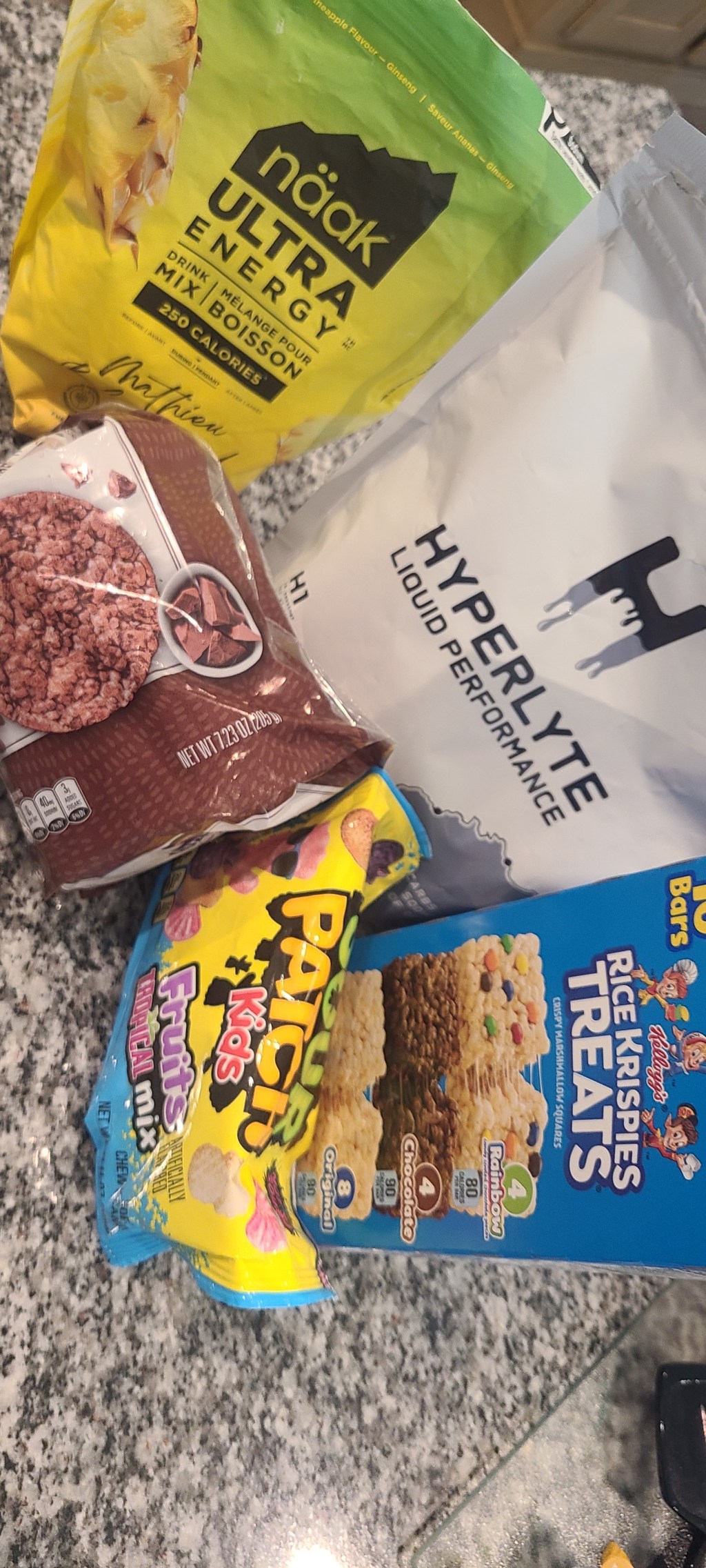
As a runner, we get these carbs from various sources: Gels, Chews, Sports drink, Bananas, Rice balls, Potatoes, Energy waffles, Candy. Each have their own pros and cons, but here’s the point: Everyone is different and wants different sources at different times and stages of the race.
That’s why practicing your nutrition is just as important as practicing your running.
| Race Duration | Carbs per Hour |
|---|---|
| Under 90 min | Usually none needed during the race |
| 1.5–2.5 hrs | 30–45 g |
| 2.5–4 hrs | 45–60 g |
| 4+ hrs | 60–90+ g (depending on training and gut tolerance) |
This chart is a starting point, not a rule. Think of them as a range to experiment with during training rather than a target you have to hit immediately.
I tell all my athletes that the long run in your training plan is not only to build endurance so you can finish the actual race, but also to practice all race-day activities, including fueling. I have them start with a basic 30-45 g/hour, then scale as the long run gets longer and how they react to the food. I personally, for a long run of 3 hours or more, need 80-85 g/hour, but that’s what I found that I needed through trial and error. You need to try different sources as well to see what works for you and what doesn’t. I cannot fuel solely on liquid carbs; I have to have some substance. After each run, put it on your training plan what you used and how many carbs were consumed so that your coach can help you navigate through the process.
Five Fueling Mistakes I See Most Often
- Waiting until you’re hungry
- Trying something new on race day
- Under-fueling because you’re afraid of stomach issues
- Eating too much at once instead of consistently
- Forgetting hydration and electrolytes
Practicing during your long runs is where you gain the confidence of fueling. It alone eliminates most of these mistakes. By the time you get to the race, you’ll have your actual strategy nailed down and will also have other options if one fails you on race day. All of this information is for nutrition and will need to be accompanied by a hydration strategy as well. Hydration deserves its own discussion, which I will cover in another article.
Remember, there isn’t one perfect fueling strategy.
The goal isn’t to copy what another runner is doing.
The goal is to discover what works for your body.
Every long run is an opportunity to practice.
Experiment.
Take notes.
Learn from each run.
By race day, fueling shouldn’t be something you’re worried about—it should simply be part of your plan.
Ready to Take the Next Step?
If you’re training for your first trail race, 50K, or ultramarathon and want personalized guidance on training, nutrition, and race-day strategy, I’d love to help.
At Black Sheep Running, my goal is simple: help everyday runners discover they’re capable of more than they ever imagined.
Learn more about my coaching here. Book Your Free Consultation


Leave a Reply